Parliament yesterday unveiled investigations into 12 critical issues affecting the country, including fuel supply, electricity, pensions, mining, passport services, prison conditions and the distribution of fertiliser coupons.
Briefing the media in Lilongwe, Speaker of the National Assembly Sameer Suleman announced the institution of joint parliamentary committees to investigate the issues, saying Parliament has a responsibility to ensure public institutions account for their performance and national resources are used for the benefit of Malawians.
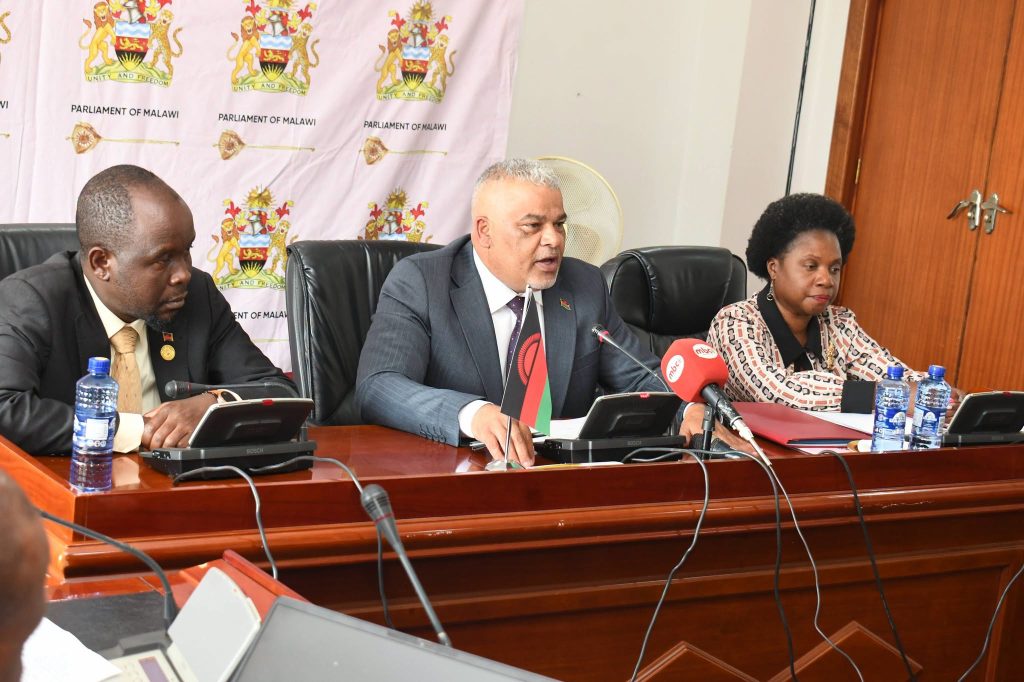
He said the inquiries follow complaints and representations from members of the public concerning household welfare, economic opportunities, access to essential services, protection of rights and management of public resources.
The committees, drawn from relevant parliamentary oversight bodies, will conduct evidence-based inquiries and present their reports at the forthcoming mid-year budget meeting, according to Suleman.
He said one of the investigations will examine the involvement of foreign and local transporters in fuel imports.
Suleman said figures from January to June this year show that the National Oil Company of Malawi (Nocma) used local transporters for 788 trips, representing 16 percent while foreign transporters accounted for 4 080 trips or 84 percent.
In contrast, local transporters handled 817 trips for Petroleum Importers Limited (PIL), representing 81 percent, while foreign transporters handled 188 trips or 19 percent.
Nocma will also face a separate inquiry over allegations that it was defrauded.
Suleman said Parliament received conflicting accounts about the alleged fraud, particularly concerning changes to banking details linked to contracts and how such changes were authorised through email.
Parliament will also investigate the stalled Salima-Lilongwe Water Supply Project amid allegations of inadequate funding and deliberate obstruction by senior public officials.
Suleman said there were allegations that some senior officials were demanding kickbacks for the project to proceed. He stressed, however, that the allegations would have to be investigated and verified.
The inquiry will involve the Budget Committee, the Committee on Transport and Public Infrastructure, and the Government Assurances and Public Sector Reforms Committee.
Pension administration will come under scrutiny following complaints about delays in accessing benefits under the contributory pension scheme and concerns over the management of the public service pension fund.
The investigation will examine possible delays, funding shortfalls and administrative failures affecting pension beneficiaries.
Parliament will further probe the procurement of water meters by Blantyre Water Board, including concerns over a governance dispute between the board and its chief executive officer and the integrity of a procurement process supported by the World Bank.
The electricity sub-sector is another major target of the parliamentary inquiries, with lawmakers set to assess whether the unbundling of the Electricity Supply Corporation of Malawi to form two other independent companies, Electricity Generation Company and re-establishment of Power Market Limited, has improved efficiency and service delivery.
The inquiry will also examine prolonged blackouts, inadequate maintenance, equipment failures, delays in obtaining replacement parts and the availability of alternative generation projects.
Passport services will also come under scrutiny following complaints about long queues, delays in obtaining passports and allegations of corruption and demands for improper payments.
Suleman said the concerns were significant because passports are essential for Malawians seeking employment, education, business opportunities and international travel.
On the justice system, Parliament will investigate delays in concluding cases and delivering judgements, including cases involving people in custody.
Suleman said Parliament was also in the process of recruiting an Independent Complaints Commissioner for the Judiciary to investigate allegations of misconduct by judicial officers.
The tobacco sector will also be scrutinised, particularly the proposed sale of tobacco held by the Smallholder Farmers Fertiliser Revolving Fund of Malawi.
The mining sector is another focus, with Parliament set to investigate allegations that Malawi could be losing revenue through unfavourable mining agreements, weak regulation and informal mining.
Suleman defended the decision to establish joint committees despite the number of issues involved, saying the approach would allow lawmakers with relevant expertise to work together rather than tackle the issues in isolation.
“Parliament should have committees that are not ceremonial, but effective,” Suleman said.
Meanwhile, political scientist Augustine Magolowondo has welcomed the move, saying joint committees could bring together expertise from different parliamentary committees.
He said the effectiveness of the inquiries would ultimately depend on whether their recommendations were implemented.
“I would hope that, from the effectiveness of oversight point of view, this is really something that one can wish succeeds,” Magolowondo said, stressing the need to ensure recommendations were followed up and implemented.
Centre for Social Accountability and Transparency executive director Willy Kambwandira, however, cautioned against celebrating the announcement, saying previous parliamentary inquiries often failed to produce tangible consequences.
Political Science Association of Malawi spokesperson Mavuto Bamusi described the move as a “great awakening” for Parliament, saying joint committees could strengthen oversight by bringing together committees responsible for related sectors.
He said the approach could help Parliament move away from working in silos.